
Air curtain – water coil or electric heater? Engineering selection guide
February 26, 2026
Which heat exchanger for a heat recovery unit should you choose? Types, efficiency and moisture recovery
March 3, 2026
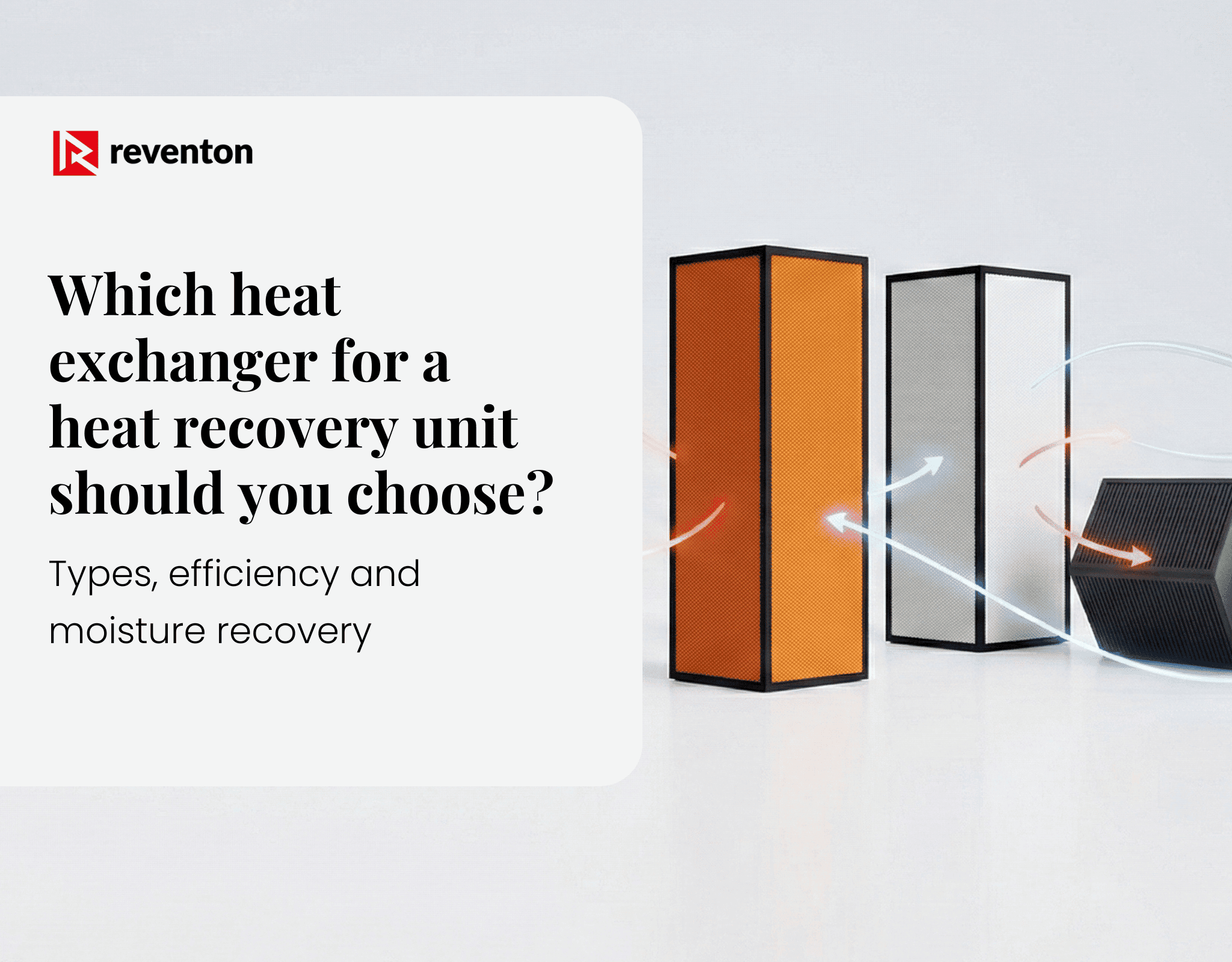
Table of contents
The heat exchanger in a heat recovery unit is the most critical component of the entire mechanical ventilation system. It determines how much thermal energy actually returns to the building, whether the system will frost up during freezing temperatures, and ultimately – what quality of air you will breathe every day.
Anyone who decides to install mechanical ventilation with heat recovery sooner or later faces a dilemma that becomes most apparent during the winter season. On the one hand, we want to minimise heating bills as much as possible; on the other hand, we want to avoid the troublesome problem of excessively dry indoor air.
In this article, we break down the types of heat exchangers in detail to help you choose the technology that ensures trouble-free operation and the highest level of user comfort.
Key takeaways
- The heat exchanger in a heat recovery unit enables energy recovery from the exhaust air and transfers it to the supply air. The two airstreams do not mix, which prevents the transfer of pollutants, viruses and odours.
- Counter-flow heat exchangers offer the highest temperature efficiency (often exceeding 90%), which drastically reduces the demand for heating energy, but they are more susceptible to frosting during freezing conditions.
- Enthalpy heat exchangers recover not only heat but also moisture. This eliminates the need for a condensate drain from the unit and allows for a significant reduction in building operating costs, particularly in winter.
- The choice of unit must be dictated by the specifics of the building – temperature efficiency is the key parameter for traditional heat exchangers, while enthalpy efficiency defines the total energy recovery (heat and moisture).
Why does the type of heat exchanger in a heat recovery unit matter so much?
Before we move on to a detailed classification, we need to cover the basics. The primary task of a heat recovery unit is to deliver fresh outdoor air while minimising heat losses that, in traditional natural ventilation, escape through chimneys. This mechanism is based on the laws of physics: warm, stale exhaust air from the rooms transfers its energy to the cool, fresh supply air drawn from outside. The entire energy exchange process takes place on the working plates of the heat exchanger.
To make an informed choice of heat recovery unit, you need to understand two parameters that manufacturers provide in their specifications:
- Temperature efficiency – this indicator shows how much energy related to the temperature difference the unit is able to recover (the heat you feel on your skin and measure with a thermometer). A higher percentage means lower heating bills in winter.
- Enthalpy efficiency – this parameter applies exclusively to units with enthalpy heat exchangers. It describes the system’s ability to recover total energy – i.e. both sensible heat and latent heat, which is the energy stored in water vapour.
Remember: From the perspective of everyday building use, it is enthalpy efficiency and the ability to manage moisture that have the greatest impact on preventing dry mucous membranes in winter and on the overall well-being of residents and employees.
Classification by geometry: how does airflow affect heat recovery?

The design of the arrangement where the airstreams meet directly determines the efficiency of the heat recovery unit. On the market, you will encounter two main solutions that differ in the path the air takes inside the unit.
Cross-flow heat exchangers
In this classic variant, the airstreams (supply air from outside and exhaust air from the building) cross each other at a right angle as they flow through the channels of the unit.
Technical characteristics:
A simple, compact cuboid structure with a square base. The path the air travels is relatively short.
Advantage:
The unit takes up significantly less space. It is characterised by smaller dimensions and lower air resistance, which reduces the load on the fans.
Benefit for the user:
Choosing an air handling unit with a cross-flow heat exchanger makes installation easier in tight spaces (e.g. low attics, narrow utility rooms) and is usually associated with a lower purchase price. However, you should expect lower heat recovery efficiency (in the range of 50–70%). In practice, this means that during severe frosts, the supply air may require additional heating from the central heating system.
Counter-flow heat exchangers
From a technical standpoint, these are most commonly cross-counter-flow designs. The airstreams cross at the inlet and outlet edges, but along the main, elongated section of the exchanger they run parallel to each other in opposite directions.
Technical characteristics:
Significantly elongated, in the shape of a prism with a rhombus or hexagonal base. The air has considerably more ‘time’ to exchange energy.
Advantage:
Maximisation of heat exchange. The temperature efficiency of such units can exceed 90% under certain conditions.
Benefit for the user:
A drastic reduction in ventilation heat losses. The air handling unit recovers the vast majority of energy from the exhaust air, which directly translates into noticeable savings on gas or electricity bills.
Operational challenge:
High efficiency comes at a cost rooted in physics. Because the exchanger ‘extracts’ the maximum amount of heat from the exhaust air, this airstream cools down significantly – often below zero in winter. This causes water to condense and freeze on the exchanger plates (frosting). Therefore, counter-flow heat recovery units absolutely require an effective anti-frost system – most commonly in the form of an electric pre-heater that activates at sub-zero temperatures, in accordance with the manufacturer’s recommendations.
Classification by function: standard heat recovery vs. enthalpy heat exchanger
The shape of the heat exchanger is only one side of the coin. The second, extremely important distinction arises directly from the material the element is made of. It is the material that determines exactly what passes through the walls of the unit.
Traditional heat exchangers (aluminium or plastic)
In this case, the physics is straightforward: only heat exchange occurs through the solid, impermeable walls. The plates are made of rigid plastic (e.g. polystyrene) or aluminium.
Technical characteristics:
The walls form a 100% barrier to moisture. Warm, humid air extracted from the rooms releases its heat upon contact with the cold plate, and excess water condenses on the surface of the exchanger (condensation). The unit requires the installation of a drip tray and a condensate drain to the sewage system.
Advantage:
Very high sensible heat exchange efficiency. These materials are extremely durable, airtight and easy to clean with water.
Benefit for the user:
This is the optimal and safest solution for buildings where dehumidifying the air is an absolute priority and where large amounts of water vapour are generated (e.g. indoor swimming pools, drying rooms or buildings undergoing finishing works). If your home has a problem with excessive humidity, a traditional heat exchanger will effectively remove it.
Enthalpy heat exchangers
This is the solution that takes ventilation to the next level. Through specially designed walls, not only heat exchange occurs but also moisture infiltration from the airstream with higher relative humidity to the airstream with lower humidity. The plates are made of special vapour-permeable polymer membranes, polyethylene or refined cellulose.
Technical characteristics:
The membrane allows water vapour molecules to pass through at a molecular level. In winter, moisture from the exhaust air does not condense into liquid water but permeates through the membrane to the dry outdoor supply air, humidifying it before it is delivered to the rooms.
Advantage:
Self-regulating moisture recovery. The absence of condensing water means no condensate, and consequently – minimal risk of the exchanger freezing during typical frost conditions.
Benefit for the user:
You deliver better ‘prepared’, naturally humidified air to your bedroom or living room. This eliminates the winter problem of stinging eyes, dry skin and shrinking wooden floors. Additionally, in many cases you save money on purchasing and maintaining external humidifiers. From an installation perspective, the absence of a condensate drain makes installation easier in locations where access to the sewage system is limited.
Which heat exchanger to choose? Exchanger comparison
To facilitate a quick analysis before making a decision, we have prepared a comparison of the key parameters of 3 heat exchangers (cross-flow, counter-flow and enthalpy):
| Parameter / Feature | Cross-Flow Heat Exchanger (Standard heat recovery) | Counter-Flow Heat Exchanger (Standard heat recovery) | Enthalpy Heat Exchanger (Cross-flow or counter-flow) |
| Temperature efficiency | Lower / Medium (50–70%) | Very high (85–95%) | High (70–85%) |
| Moisture recovery from exhaust air | None | None | Yes |
| Condensate drain to sewage | Required | Required | Not required |
| Risk of frosting in winter | Medium | Very high | Minimal |
| Main application | Buildings with a limited budget and no technical infrastructure | Passive houses and buildings focused on maximum heating cost reduction | Buildings focused on the highest comfort (no dry air) and stable operation in freezing conditions |
Summary
How to match a heat recovery unit to your needs?
A properly selected air handling unit should operate quietly, reliably and effectively reduce your costs. For the heat recovery unit to fulfil its purpose, the heat exchanger must be matched to the specifics of your building and your personal expectations. There is no single ‘best’ type of heat exchanger for every situation.
If your priority is an extreme reduction in the cost of heating the supply air and you are building a passive-standard house, a counter-flow heat exchanger will be the right choice – you just need to account for the necessity of condensate drainage and the operation of the pre-heater.
If, however, you value comprehensive comfort, want to avoid the problem of dry air during the heating season and minimise the risk of failure due to condensate freezing, an enthalpy heat exchanger with moisture recovery will perform significantly better.
Still unsure which air handling unit will work best for you? Contact our team of technical advisors. We will help you choose a solution tailored to your real needs, ensuring fresh air and many years of trouble-free system operation.
FAQ
1. Does an enthalpy heat exchanger transfer unpleasant odours from the bathroom and kitchen back to the living room?
This is not possible. Modern membranes used in enthalpy heat exchangers operate at a molecular level. They are permeable only to very small water vapour molecules. Larger gas molecules (responsible for odours), as well as pollutants, moulds, viruses and bacteria, are blocked, ensuring complete hygiene of the supply air.
2. How do you maintain the cleanliness of the heat exchanger in a heat recovery unit? Can it be washed?
It depends on the material. Traditional cross-flow and counter-flow heat exchangers made of plastics (e.g. PET) or aluminium can be safely removed from the unit and rinsed with lukewarm water and a mild detergent. In the case of enthalpy heat exchangers, special care must be taken. Modern polymer membranes can be gently rinsed with water (in accordance with the manufacturer’s instructions), but older cellulose-based exchangers must never be soaked – they can only be blown out with compressed air.
3. When exactly does the anti-frost system (defrosting) activate?
In standard counter-flow heat exchangers, water condenses almost throughout the entire winter. When the temperature of the outdoor intake air drops below zero, this water freezes. The heat recovery unit’s automation then activates the pre-heater to warm the intake air, or temporarily reduces the supply airflow, heating the exchanger with the exhaust air. Enthalpy heat exchangers, by minimising condensation in the form of liquid water, shift this freezing point and can operate without defrosting down to -7°C / -10°C, which saves electrical energy.


