
Why is your unit heater blowing cold air? 5 hydraulic mistakes and how to fix them
January 30, 2026
Which heat exchanger for a heat recovery unit should you choose? Types, efficiency and moisture recovery
March 3, 2026
Air curtain – water coil or electric heater? Engineering selection guide
February 26, 2026
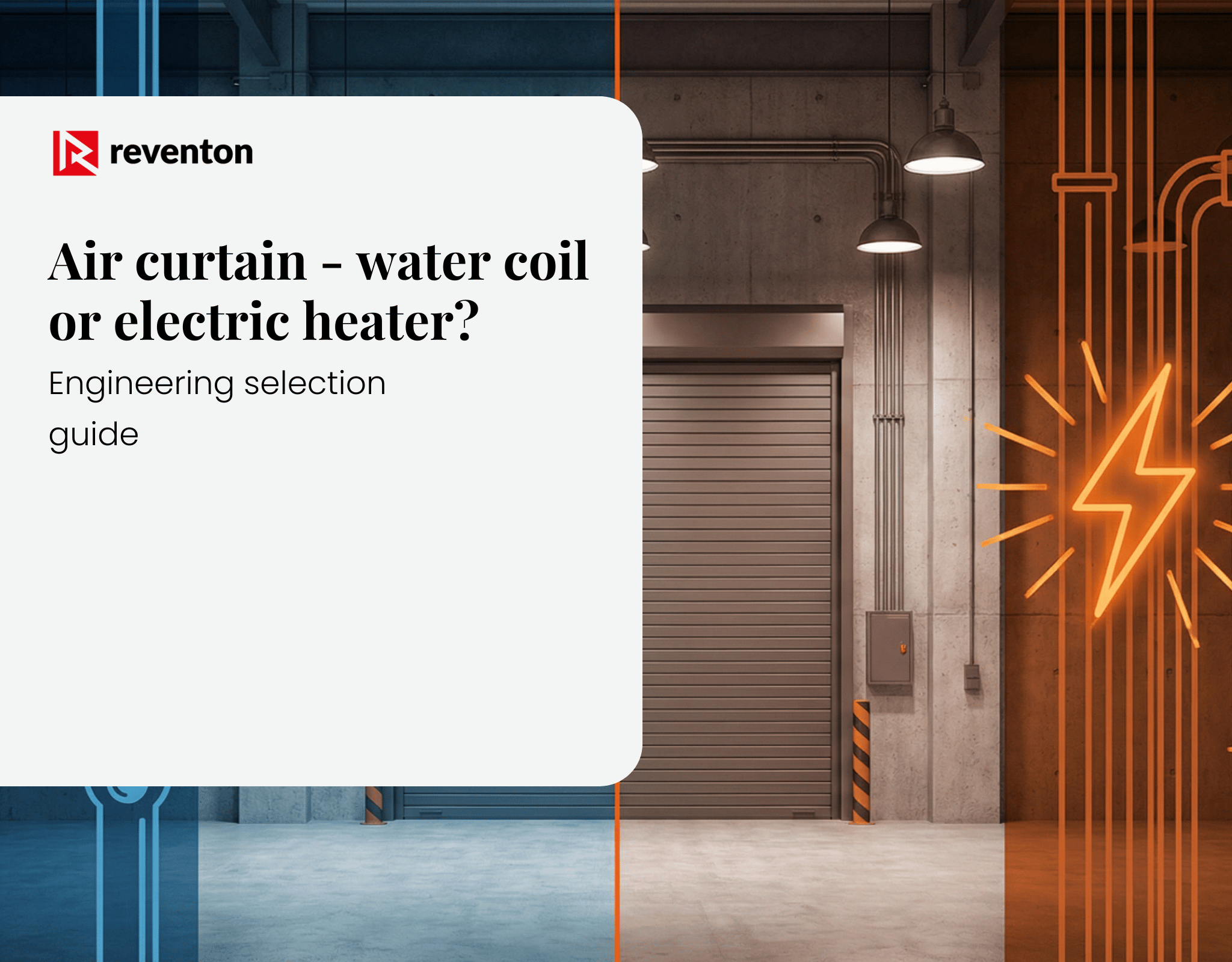
Table of contents
- Key takeaways
- What determines the choice of the air curtain type?
- Where does the money go, or water vs. electricity in numbers?
- Cost comparison (Estimated market values)
- When does the investment pay off?
- Does photovoltaics change the rules of the game?
- Comparison of the HUMMER industrial series solutions
- Why does vertical installation often win in logistics?
- Technical limitations – what must the Designer remember?
- Installation and maintenance – Contractor's perspective
- How does the air curtain pay for itself outside the heating season?
- FAQ – Technical questions
A dilemma often arises on the construction site: the designer specifies water coil air curtains due to lower operating costs, while the contractor proposes electric ones – simpler to install and cheaper upfront. Who is right? Both of them – but in completely different time horizons.
In this article, we will analyze when it is worth delving into the water system, and when a power supply cable will be the only reasonable choice. We base this on hard data for a typical 4.0 x 4.0 m industrial door.
Key takeaways
- An electric air curtain is more expensive to purchase than a water coil unit (the difference in the price of the device itself), but the installation is simpler – it only requires a power supply, without the need to build a water system.
- Despite the cheaper water-based device, the entire installation (hydraulics) costs more upfront, but it pays off thanks to cheaper heat (gas/district heating). Heating with gas is significantly cheaper than mains electricity (the difference depends on current energy prices).
- The higher cost of the water system pays off within a few heating seasons (the time depends on the intensity of use).
- Electric air curtains are unmatched in facilities with a photovoltaic installation or where there is no access to a heating system.
- A water coil air curtain requires freezing protection and appropriate valves. An electric air curtain requires ensuring sufficient power supply capacity.
- An air curtain is not a heater – its main task is the separation of zones, and heating the air is a function supporting comfort.
What determines the choice of the air curtain type?
To select a device, do not ask “what is cheaper in the catalogue”, but rather “what infrastructure is available at the facility”. The decision should be based on three pillars:
Utility availability
Is heat from the system or gas supplied to the doors? If not – the cost of making the connection can kill the profitability of the water coil version.
Electrical power balance
An industrial air curtain for a 4 x 4 m door in practice has a heating capacity of around 35 – 40 kW. For the electric version, this means the necessity to secure a massive power capacity (high amperage, power consumption of up to 40 kW). In older facilities, the available power supply may be insufficient.
Facility operation characteristics
Does the door open cyclically, or is it constantly open?
- In large-volume facilities with their own boiler room, an air curtain – water coil is the most common choice.
- If you are modernizing a rented hall and cannot interfere with the existing water system – an air curtain – electric heater is often the only option.
Where does the money go, or water vs. electricity in numbers?
Let’s compare the costs for a typical dock door (4 x 4 m).
Assumptions from the Case Study (January 2025):
- Electricity price: 0.90 – 1.20 PLN/kWh
- Gas price (for heating water): 0.30 – 0.40 PLN/kWh
Scenario A: Air curtain – water coil
- Advantages: low operating costs thanks to cheap heating water. Reliable design – the hot water coil is a simple component without control electronics.
- Disadvantages: complicated installation. The need to route pipes, install valves, actuators, and a pump. Risk of medium freezing if automation fails (freezing protection required).
- Summary: higher initial cost, but with intensive use, the investment can pay off in the first season.
Scenario B: Air curtain – electric heater
- Advantages: you mount the device, connect it to the power supply, and it works. No risk of leakage or freezing.
- Disadvantages: very high electricity bills. With intensive work in winter, the monthly energy cost for one door can be significantly higher than in the water coil version.
- Verdict: perfect where water system installation is technically impossible or unprofitable (e.g., a door opened once a day).
Cost comparison (Estimated market values)
- Device cost: Lower (standard heat exchanger) vs. Higher (costly high-power PTC heating elements)
- Installation cost: High (water system, valves, leak tests) vs. Medium (only cable route, but thick cross-sections)
- Supply medium: Boiler water (e.g., gas boiler) vs. Mains electricity (C Tariff)
- Estimated cost of 1 kWh of heat: approx. 0.30 – 0.40 PLN (Gas) vs. approx. 0.90 – 1.20 PLN (Electricity)
When does the investment pay off?
Although the overall investment in a water system is higher upfront, a water coil air curtain usually starts generating savings within a few heating seasons (depending on the intensity of use and the difference in energy prices).
BUT! The electric air curtain wins when:
- The investor has a photovoltaic installation
- Lack of access to a heating medium
- Infrequent door opening cycles
Does photovoltaics change the rules of the game?
Yes, and drastically. In this case, the electric air curtain wins in TCO. If the investor has a photovoltaic installation that generates energy surpluses, the cost of powering the electric air curtain drops to almost zero (excluding distribution fees). In such a setup:
- We eliminate costly hydraulics (CAPEX down).
- We have “free” fuel (OPEX down).
In this case, it is worth considering the integration of air curtains with a Building Management System (BMS) – then the heating turns on only when the door is open, which limits energy consumption.
Comparison of the HUMMER industrial series solutions
- Heating capacity: 20 – 70 kW (depends on medium temp.) vs. 6 – 24 kW (constant, depends on model)
- Power supply: 230V (fan only) vs. 400V (3-phase for PTC heaters)
- Current consumption: Low (e.g., 2.5 A) vs. Very high (e.g., 35 A)
- Device weight: Higher (water coil + water) vs. Lower (PTC heating elements)
- IP rating: IP 54 vs. IP 54
- Max. range: Up to 7-8 meters vs. Up to 7-8 meters
Additionally, for doors opening upwards, horizontal installation above the opening is impossible – the open door would cover the air curtain.
Why does vertical installation often win in logistics?
Range problem
The key is the airspeed at the floor level (min. 2-3 m/s required). If an air curtain hanging 5 meters above the ground is too weak, the heat will escape at the bottom. Money down the drain.
Vertical solution
For wide industrial doors, it is better to mount vertical columns on the sides. Often the door opens upwards and therefore there is no possibility of horizontal installation above the door. In such a case, an electric air curtain is a better choice.
Routing a cable to a vertical column is simpler than a water installation – there is no air venting problem, and the whole thing looks aesthetically pleasing.
Technical limitations – what must the Designer remember?
- Available electrical power (Electric Air Curtains)
- Freezing protection (Water Coil Air Curtains)
Installation and maintenance – Contractor’s perspective
- Challenges with a water coil air curtain: Weight, Water system
- Challenges with an electric air curtain: Cabling, Electrical installation
How does the air curtain pay for itself outside the heating season?
We debunk the myth that an air curtain only works in winter. In summer, the air curtain acts as a shield against insects, dust, and exhaust fumes (which is crucial in the food industry).
Additionally, the air curtain keeps the air-conditioned air inside. In ventilation-only mode, “water coil” and “electric heater” air curtains consume the same amount of electricity (only the fan), so the differences in costs disappear.
Summary The “water or electricity” dispute does not have a single winner – everything comes down to the available infrastructure and TCO (Total Cost of Ownership). The decision should be made based on a cold calculation, not the price of the device itself:
- Choose an air curtain – water coil if the facility has its own gas boiler room and the doors are used intensively. The higher cost of the complicated water system and valves will pay off in lower heating bills after just a few seasons.
- Choose an air curtain – electric heater if the investor has a photovoltaic installation (this is a “game changer” that reduces operating costs to a minimum), lacks access to heating media, or you are modernizing a rented hall. It is also an unmatched option for vertical installation and in places where routing pipes is technically impossible.
Remember that an air curtain is a year-round investment – in summer, it protects against heat, insects, and dust just as effectively, regardless of the heat source. The final choice should therefore be dictated by the balance of available power and media, because that is where – and not in the purchase price – the real savings are hidden.
FAQ – Technical questions
1. How to protect a water coil air curtain against freezing?
This is a frequent question. We use two solutions:
- Automation: An anti-freeze thermostat, which, when the temperature drops near the door, forces the valve to open and ensures a minimum flow of hot water.
- Glycol: Filling the system with a glycol solution (the most reliable method, but it reduces the heat exchange efficiency by more than ten percent).
2. Can a water coil air curtain work with a heat pump?
It can, a heat pump is a heat source analogous to e.g., a gas boiler. However, it should be taken into account that it is a low-temperature source, which means a lower heating capacity of the water coil air curtain.
3. Does an ambient air curtain (without heating) make sense in a heated warehouse?
Yes. An ambient air curtain creates an air barrier that limits heat loss through the door opening.
4. How to control the air curtain so it does not generate costs when the door is closed?
It is best to use a door switch or integrate the air curtain with a Building Management System (BMS). Then the air curtain turns on automatically only when the door is open.