How to connect a low pressure hot water unit heater and avoid service call-outs – an installer’s guide
January 29, 2026
Air curtain – water coil or electric heater? Engineering selection guide
February 26, 2026
Why is your unit heater blowing cold air? 5 hydraulic mistakes and how to fix them
January 30, 2026
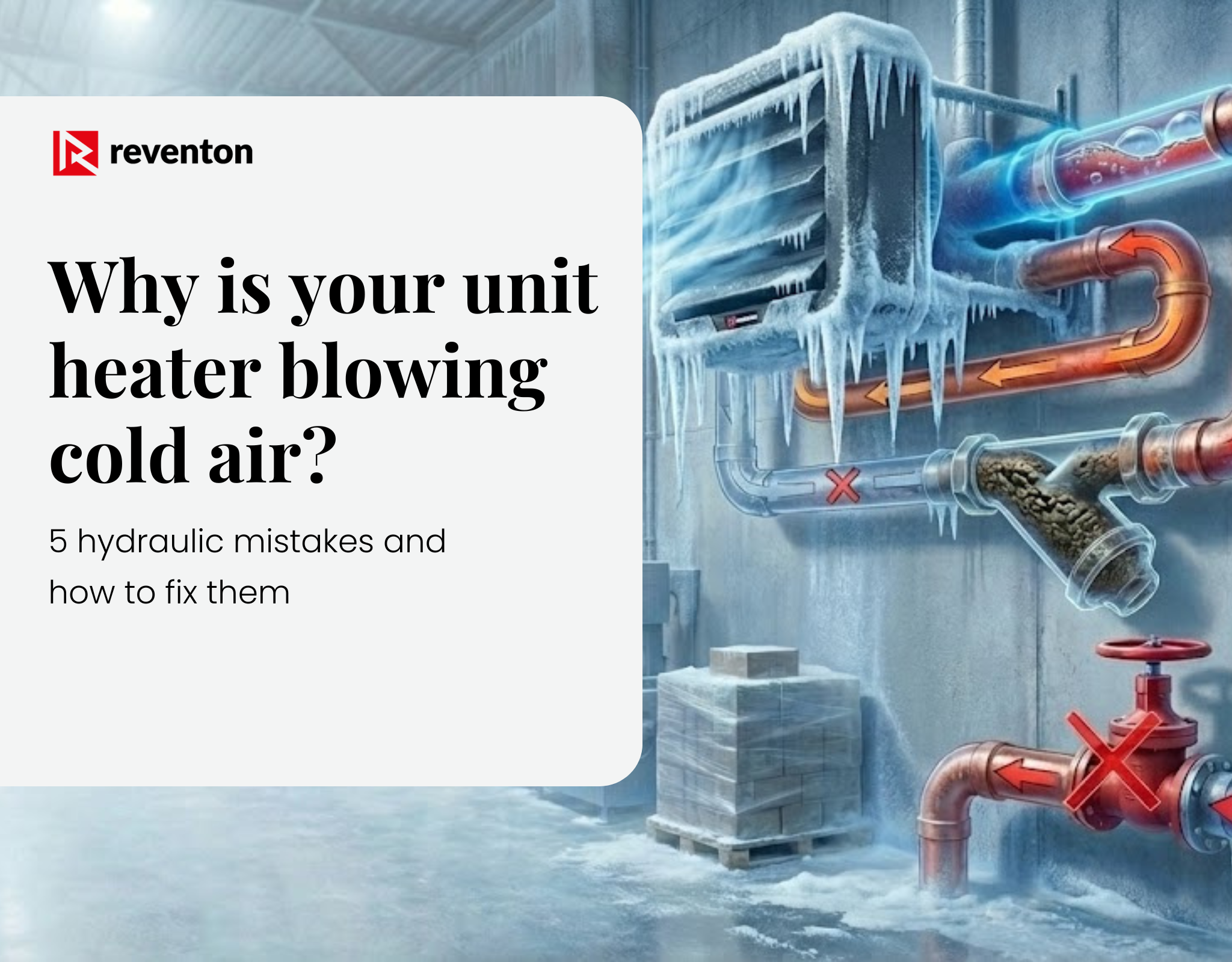
Table of contents
- Key takeaways
- Low pressure hot water unit heaters require bleeding – did you do it?
- Where did you install the 3-way valve? (The “cold start” problem)
- Supply or return – did you mix up the connections?
- Is the circulation pump generating sufficient pressure?
- Have you replaced a boiler with a heat pump but kept old industrial unit heaters?
- Summary
- FAQ – Technical questions
“Mr Wojtek, it’s a brand-new water unit heater and it’s blowing cold air!”
This is a sentence I hear every winter. The controller shows heating mode, the fan is running at full speed, and workers in the hall are wearing jackets.
Before you call to make a warranty claim, read this first. In 90% of cases the unit is fully operational, and the problem lies in physics and hydraulics, not in the heater itself.
Key takeaways
- Air is an insulator: Even a small amount of air trapped in the heat exchanger can reduce heating output to zero.
- The “cold start” effect: Incorrect placement of a 3-way valve causes cyclic blasts of cold air.
- The heat pump trap: Old installations + a new low-temperature heat source = a dramatic loss of heater output unless units are upgraded to 2- or 3-row heat exchangers.
Low pressure hot water unit heaters require bleeding – did you do it?
It sounds trivial, but this is the most common installation mistake.
Water unit heaters (e.g. the HC series) are usually installed several metres below the ceiling — often on columns in large halls — and are therefore the highest point in the system. According to the laws of physics, air bubbles rise upwards.
If you only bleed the manifold in the boiler room and do not bleed the heater itself at 4–5 metres height, an air pocket forms inside the heat exchanger. Water simply cannot flow through it.
Symptom: The top of the casing is cold, the bottom is warm — the heater does not heat.
Installer solution:
Bleed the system using the air vent installed at the highest point of the installation — in this case, the upper connection of the heater.
Where did you install the 3-way valve? (The “cold start” problem)
The cold start effect occurs when the flow of hot water through the heat exchanger is cut off by a valve. Hot water, unable to circulate, remains in the pipe near the valve supplying the heater and cools down.
When the valve opens again, the first medium entering the heater is already cooled — this is what we call a cold start.
This phenomenon typically occurs when 2-way valves are installed on the supply line to the heater.
Solution:
Use 3-way mixing valves, or install the valve in such a way that hot water circulates in a local loop close to the unit (via a bypass). Hot water must be “waiting” right next to the heater.
Supply or return – did you mix up the connections?

Our low pressure hot water unit heaters are designed in a counterflow configuration. This means that the hottest water should meet the warmest outlet air, while cooler water meets incoming air.
Mistake: Connecting the supply to the return connection (swapped stubs).
Result: A reduced average temperature difference (LMTD) and a drop in heating capacity by several percent — in extreme cases, even more.
Verification:
Check the markings on the unit or in the technical documentation. The connections are marked with red caps (supply) and blue caps (return).
Is the circulation pump generating sufficient pressure?
A common scenario in large halls:
The designer selected pipe diameters “on the edge”, and the installer used PEX fittings with severe restrictions.
Result: Hydraulic resistance becomes so high that the pump cannot deliver the nominal flow rate (e.g. 4,000 l/h for a large unit heater).
Diagnosis:
Measure the temperature difference (ΔT) between supply and return with the fan running.
- Example: Supply 70°C, return 30°C → ΔT = 40 K
This means the flow rate is far too low — water is “standing” in the exchanger and releases all its heat at the beginning.
A correct ΔT is typically 10–20 K.
Have you replaced a boiler with a heat pump but kept old industrial unit heaters?
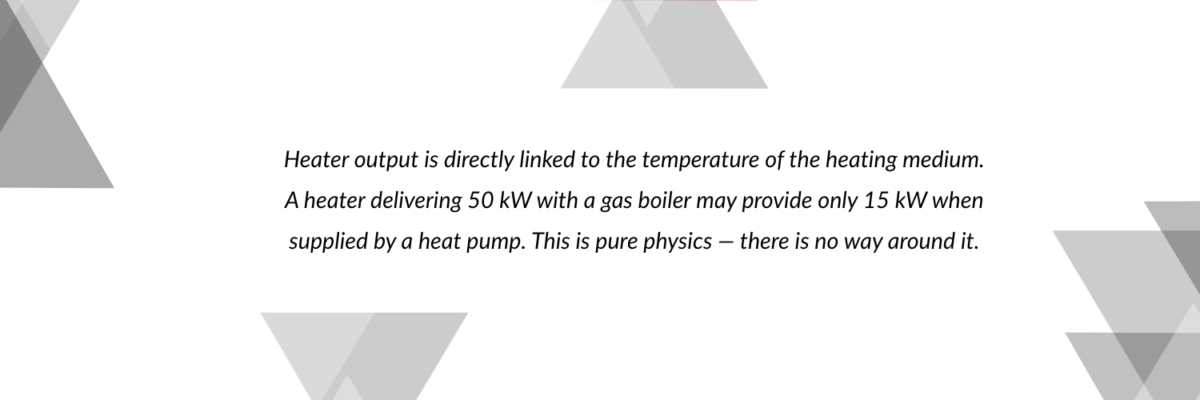
This is a critical point for investors modernising buildings.
Old gas or coal boilers supplied water at 80/60°C.
Heat pumps typically supply a maximum of 45/35°C.
Symptom:
Everything works, nothing is airlocked, yet the heater blows lukewarm air (around 25–28°C) — which feels cold due to the air velocity.
Conclusion:
Existing heaters must be recalculated and often replaced with units designed for low-temperature operation (e.g. multi-row heat exchangers).
Summary
Remember: low pressure hot water unit heaters are simple devices. If they receive the right amount of hot water, they must heat.
Before picking up the phone, ask yourself:
- Has the system been bled at the highest point (directly at the heater connection)?
- Is the 3-way valve installed to eliminate the cold start effect?
- Are supply and return connected correctly (counterflow)?
- Are pipe diameters not choking the pump (check ΔT)?
- Have the heaters been recalculated for the low temperatures of a heat pump?
A correct diagnosis saves time and frustration — both yours and that of the client freezing in the hall.
FAQ – Technical questions
Q: How can I check if a unit heater is airlocked without climbing a ladder?
A: Touch the supply and return pipes near the manifold.
If the supply is hot and the return is unnaturally cold (much colder than on other circuits) with the valve open, the most likely cause is no flow due to an air pocket at the highest point.
Q: Can I fill the system with glycol to prevent freezing?
A: Not entirely. Our heat exchangers are not designed to operate on pure glycol.
The maximum concentration is 50% glycol / 50% water.
Keep in mind that glycol has worse heat transfer properties than water. Using a water–glycol mixture can reduce heater output by up to 15%.